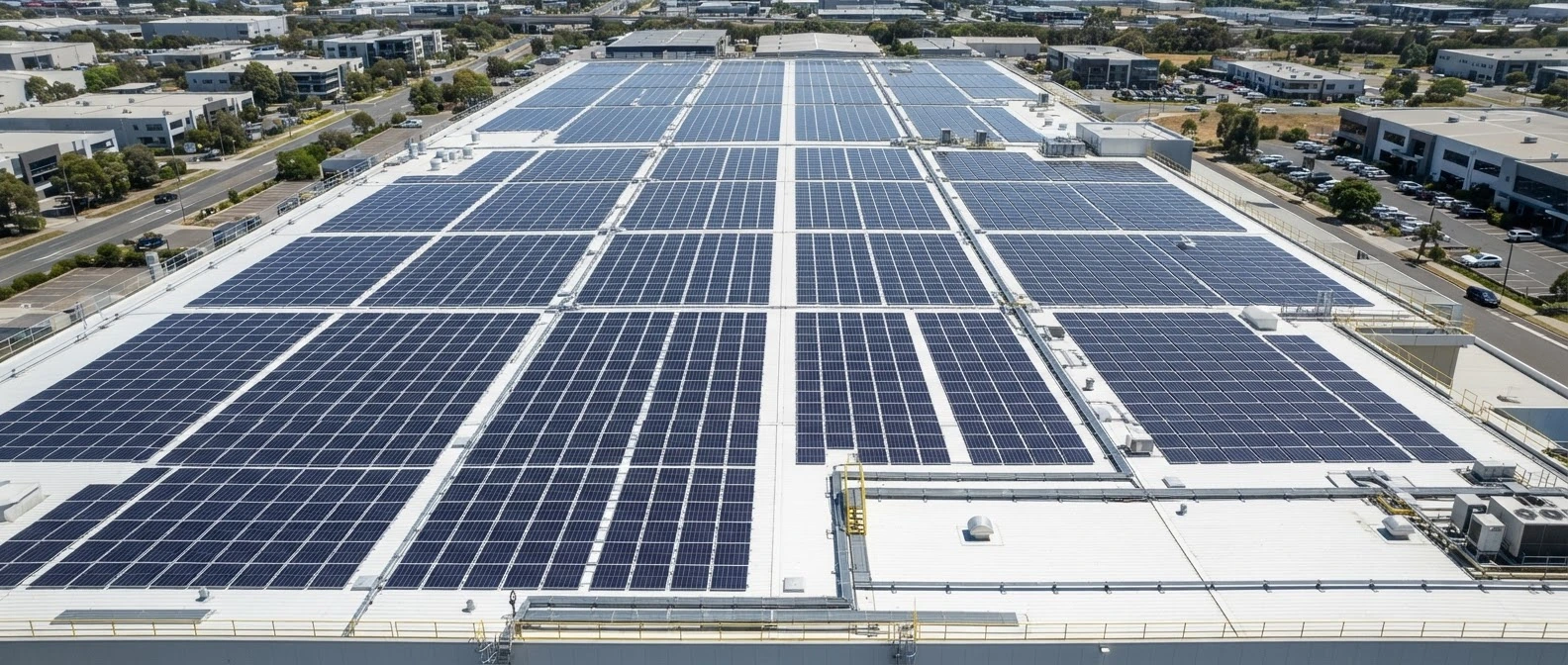
Solar, engineered around your load.
Complete solar EPC for commercial, industrial and institutional sites. We design from how your site uses energy, build to a documented engineering standard and keep the system ready for storage and control.
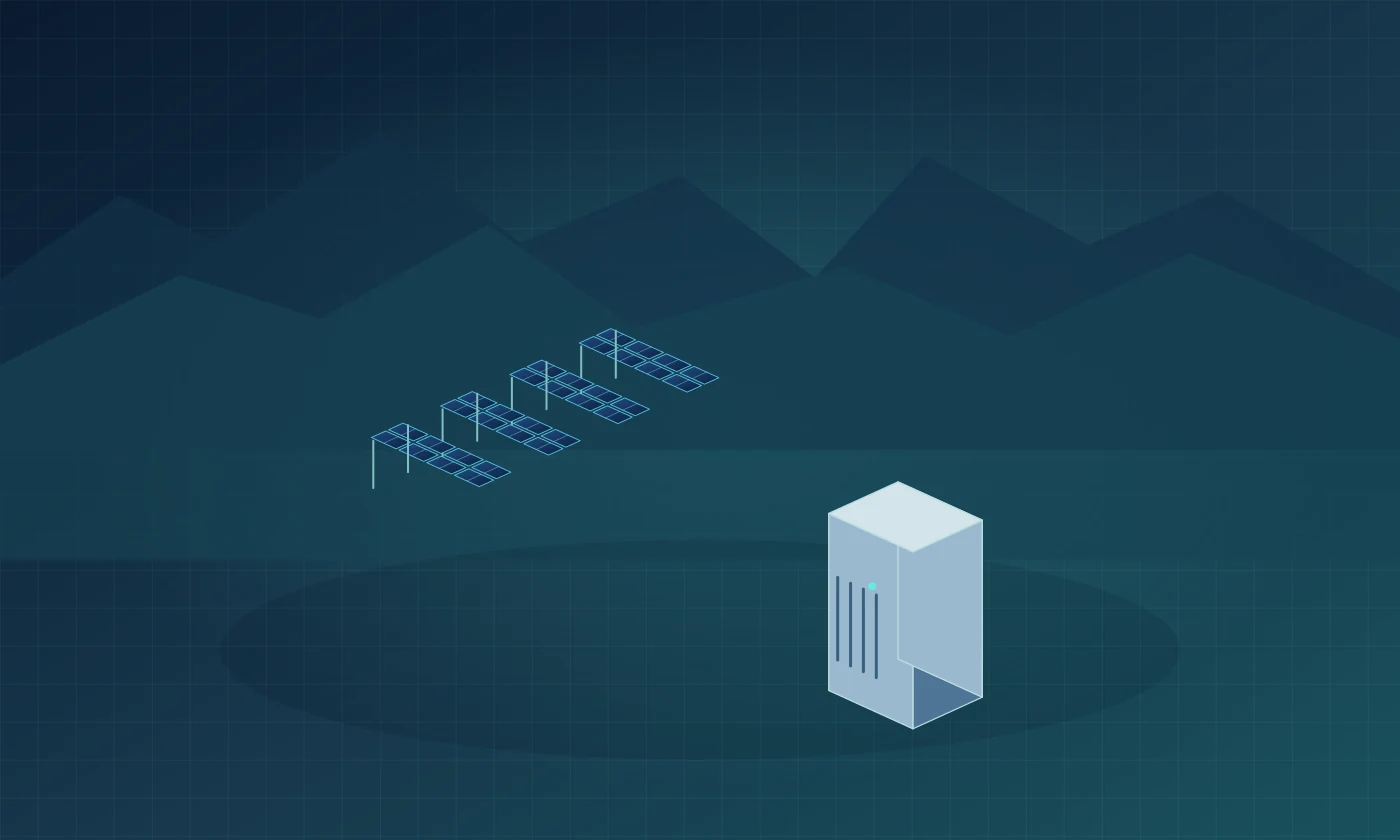
From modules on the roof to the meter at the gate.
Follow the energy path of a new solar plant on an industrial shed, then switch to a grid interruption to see why grid-tied inverters must stop, and why we keep the design storage-ready.
One engineering state. The plant view, the single-line diagram and the graphs below follow the same configuration rules as the Energy Explorer. Motion and wording show behaviour only; no ratings, sizes or savings are implied.
01How it operates
- Modules convert sunlight to DC; strings are formed within the inverter’s voltage window.
- Inverters track the maximum power point and synchronise to the grid.
- The ACDB combines inverter outputs with breakers and surge protection into the LT panel.
- Utility-approved metering records generation and any export.
02When it makes sense
- Daytime-heavy loads: offices, workshops, schools, single-shift plants.
- Strong roofs or open land with little shading.
- Sites where storage can be added later: we leave space and protection for it.
- Any site that wants the lowest-cost energy first.
03Engineering constraints
- Grid-tied inverters switch off during a grid failure (anti-islanding) unless a grid-forming source is present.
- Roof strength, waterproofing and wind loading need a structural check.
- Net-metering and export permissions depend on the utility and category.
- Module cleaning access and walkways are designed in, not added later.
Generation against the shape of your load.
Solar follows the sun; your load follows your operations. The overlap is what solar alone can cover; the gap after sunset is what storage would address later.
Solar output is zero at night, rises after sunrise, peaks near solar noon and falls to zero by sunset. Haze or cloud lowers the whole curve. Load continues after sunset, which is the gap storage fills.
Factory · two shifts: Production follows the shift pattern; the second shift runs into the evening peak.
Solar modules, inverters and their limits.
Working mechanism, where it connects in the single-line diagram, its operating profile, and what limits and protects it. All equipment
Solar PV and inverters
Modules turn sunlight into DC; inverters track the maximum power point and convert it to grid-synchronised AC.
Solar inverter ≠ grid-forming PCS. A standard solar inverter is grid-following: it needs an existing voltage to follow and must disconnect when the grid fails. It keeps producing in an outage only behind a grid-forming PCS.
- Output follows sunlight: nothing at night, less in monsoon and haze
- String voltage must stay inside the inverter window at every temperature
- Export may be limited by the utility connection
One team from first bill to final handover.
Engineering, procurement and construction are only as good as the data behind them. Every stage is recorded in the Samvora platform, so nothing is lost between survey, design and site.
Rooftop generation · LT distribution · shift and daytime loads
- 01Site assessment & load analysis
Bills, TOD split, sanctioned load, operating hours and site constraints.
- 02Solar design & engineering
Layout, yield, structure, string design, SLD, protection and cable sizing.
- 03Procurement
Modules, inverters, structures and BOS chosen for the site, not from a catalogue.
- 04Installation
Tracked materials, quality checkpoints and site safety.
- 05Testing & commissioning
Insulation, polarity, protection and performance checks before energisation.
- 06Net metering & documentation
Technical documents for applicable utility approvals, coordinated with you.
- 07Monitoring & service
Performance tracked against design, with service for the life of the plant.
Solar is where the system starts.
Solar alone cuts daytime import, but it stops at sunset, and grid-tied inverters switch off in an outage by design. We lay out every solar project so a battery, PCS and EMS can be added cleanly later.
Grid energy drawn in each tariff window and the highest demand of the day, before and after storage. Bars are relative to the no-storage case; actual tariffs and savings depend on the utility category and are calculated only from your bills.
Commercial, industrial, institutional and residential.
Our focus is commercial and industrial energy; the same engineering discipline applies to institutions, societies and homes.
- Factories & manufacturing
- Stone crushers
- Warehouses
- Hotels & restaurants
- Hospitals
- Schools & colleges
- Commercial buildings
- Showrooms
- Petrol stations
- Housing societies
- Residential
Solar EPC, answered.
How do you size a commercial solar system?
From your load profile, not your roof area: 12 months of bills, TOD split, operating hours and, where available, interval meter data. Roof or land, structure and electrical capacity then set the practical limits.
Can the system be expanded with a battery later?
Yes. Inverters, metering, space and protection are laid out with future storage in mind, so a BESS and EMS can be added without redesigning the site.
Do you handle net-metering and approvals?
We prepare technical documentation for applicable utility approvals and coordinate the process with you. Timelines and requirements depend on your utility and consumer category.
What happens after commissioning?
The system is handed over with documentation and connected to monitoring, with service and lifecycle support available.
See how this would work at your site.
Answer a few visual questions and see your site today and with Samvora: at midday, in the evening peak and in a power cut. No sign-up; nothing is sent until you choose.
Start with how your site actually uses energy.
Share a few details and your recent bills. A Samvora engineer reviews your load, tariff and reliability needs before anything is proposed.