Home/Solutions/Industrial microgrid
Less grid dependence · engineering capabilityYour own controlled power system, with the grid as one source among several.
For plants on weak rural feeders, sites with long outages and operations that run on diesel today. Solar, storage, a grid-forming converter and your generator are engineered with protection and one EMS, so the site can run connected or on its own.
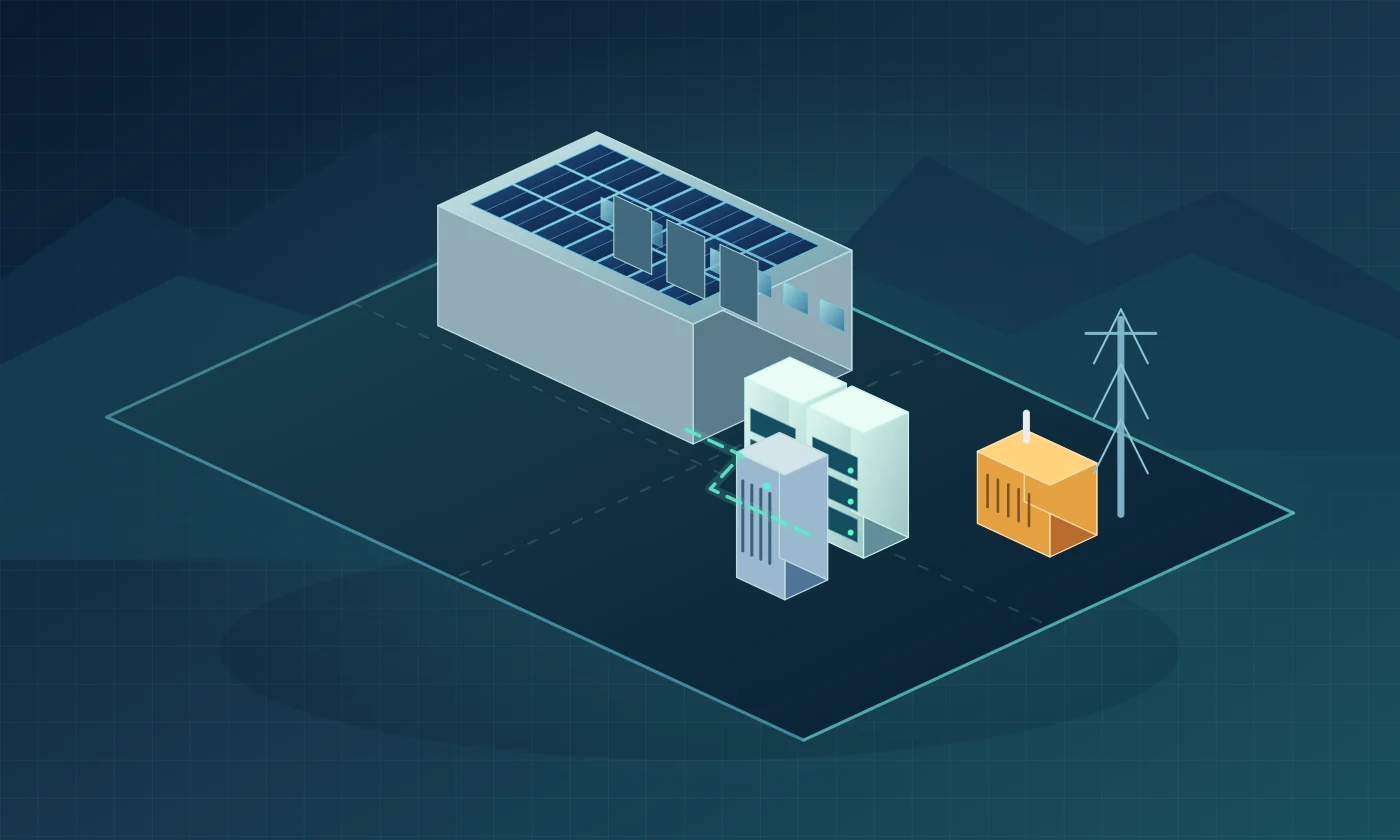
One controlled island: solar, storage, generator and loads.
An off-grid plant with no utility at all. Switch scenarios to see the generator dispatched less often and the grid-forming PCS holding the island through motor starts.
One engineering state. The plant view, the single-line diagram and the graphs below follow the same configuration rules as the Energy Explorer. Motion and wording show behaviour only; no ratings, sizes or savings are implied.
01How it operates
- A grid-forming PCS (or the DG when the battery is low) sets voltage and frequency.
- Solar inverters follow the formed grid and act as a fuel saver.
- The EMS dispatches the DG for fewer, better-loaded hours and charges the battery while it runs.
- Loads are ranked so the island never collapses under a large start.
02When it makes sense
- No grid, or a grid so weak the site already runs on DG.
- Remote plants, farms, mines and camps.
- Sites where fuel cost and logistics dominate energy cost.
- Owners who want independence planned in stages.
03Engineering constraints
- Island stability under motor starts and load steps must be studied.
- Protection must work with the lower fault current of converter-based sources.
- Spinning reserve and redundancy decide how many sources run at once.
- Control and communication failures need defined fallback modes.
Energy balance and generator loading.
In a microgrid every unit of load must be met on site, every moment. The generator is dispatched for fewer, better-loaded hours.
Supply always equals demand: solar first, then the battery in the windows the EMS chooses, then the grid. Charging appears below the axis. Shape from the illustrative model; real balance comes from metered data and the engineering model.
Generators are least efficient at light load: fuel per unit of energy rises steeply below roughly half load. A hybrid system lets the DG run less often and, when it runs, closer to its efficient loading. The curve is a qualitative shape; your generator’s own data decides real figures.
The generator, under EMS control.
Working mechanism, where it connects in the single-line diagram, its operating profile, and what limits and protects it. All equipment
Diesel generator (DG)
An engine-driven alternator, rated in kVA, that becomes the last-resort source once storage carries short outages.
DG kVA ≠ real power (kW). A generator is rated in kVA. The real power it delivers depends on the load power factor, and its step-load capability limits how much load it can pick up at once.
- Start-up delay before it can take load
- Step-load and transient limits
- Fuel logistics and maintenance by run hours
The grid alone is not enough.
Voltage dips, frequent trips and scheduled cuts on rural feeders.
Interruptions too long for a UPS and too frequent to accept.
Diesel is the main source for much of the day.
Expansion is limited by the connection, not the business.
Equipment added over time that does not work as one system.
Quarries, pumping and agro sites far from the network.
Three control layers, one site bus.
- PrimaryGrid-forming PCS
Holds voltage and frequency and shares load with the generator when islanded.
- SecondaryEMS set-points
Dispatches battery, solar and generator, protects the reserve and sheds load by priority.
- TertiaryScheduling
Tariff windows, production plans and maintenance, planned day by day.
Explore grid independence.
Describe your sources, process loads and backup priorities. The shared plant and electrical views explain the pathway and the permissions still requiring review.
Find My Energy SolutionThe link preselects an interest, not grid conditions, installed equipment or islanding permission.
What makes a microgrid work in the field.
Each microgrid is a project-specific engineering study. These are the questions every study answers.
| Topic | Engineering question |
|---|---|
| Island protection | Converters supply limited fault current. Are protection settings and earthing valid both grid-connected and islanded? |
| Transitions | How does the site move into and out of island mode, and which loads see the transition? |
| Black start | Can the site restart from the battery after a full shutdown, and in what order? |
| DG coordination | Parallel operation with the PCS, minimum loading, and start/stop rules. |
| Motor loads | Starts sequenced and drives specified so islanded operation stays stable. See VFD & motor starting. |
| Communication | Metering points, protocols and fallback behaviour if a link is lost. |
Start with a supply study.
Microgrid design starts with how the site is supplied today and what must keep running.
- Outage and voltage history
- Generator rating and run hours
- Load profile and critical loads
- Motor list and starting methods
- Single-line diagram
- Transformer and feeder details
- Space for PV, battery and PCS
- Expansion plans
Microgrids, answered.
What makes a site a microgrid?
A microgrid can run connected to the grid or on its own, with its own sources, storage, protection and a controller that keeps voltage, frequency and load in balance in both modes.
Do I have to disconnect from the grid?
No. Most industrial microgrids stay grid-connected and island only when needed. The grid becomes one source among several, used when it is the best option.
Has Samvora built microgrids before?
Microgrid engineering is a project-specific study at Samvora. We publish project records only after verification and owner approval; see our Projects page for what is verified today.
See how this would work at your site.
Answer a few visual questions and see your site today and with Samvora: at midday, in the evening peak and in a power cut. No sign-up; nothing is sent until you choose.
Start with how your site actually uses energy.
Share a few details and your recent bills. A Samvora engineer reviews your load, tariff and reliability needs before anything is proposed.